The Table's Turn
In late 2011, Italy was in a bind. The PIGS (Portugal, Ireland, Greece and Spain), considered part of the European periphery, were poorly managed and in crisis. Italian bonds were also stressed on concerns of its high debt levels and deficits. France’s President Nicolas Sarkozy was at the EU Summit in Brussels and was asked whether he thought Italian Prime Minister Berlusconi could be trusted to implement agreed reforms. Sarkozy exchanged humorous glances at German Chancellor Angela Merkel and visibly suppressed a laugh. Throughout the crisis, France was part of the responsible ‘core’ with a AAA rating, a creditor nation lecturing debtors.
A little over a decade later, Italian 10-years have been trading below French yields for most of the summer. Italy’s debt-to-GDP ratio has fallen from 154% to 139% since 2020. Prime Minister Meloni and the expiration of the Superbonus renovation scheme cut the deficit from 8% of GDP to 3%. France, on the other hand, has seen fiscal deficits of over 5% of GDP for the past four years. Legal & General switched from OATs (French bonds) to BTPs (Italian bonds). Japanese investors are cutting exposure to France.
The market is concerned about France’s upcoming election. There are about 30 people contesting the presidency. The leading candidate is Marine Le Pen with about 33% of the vote. Le Pen has claimed €125 billion in savings via state cuts, immigration reductions and EU contribution cuts. But she’s also committed to pension reform allowing retirement at 60 if you had started working before 20. A separate scheme that would waive pension contributions for anyone working over 60 would already cost €9 billion per year. The number two candidate in the polls is Jean-Luc Melenchon, a far-left candidate who promised to cancel ECB-held debt in a pan-European negotiation. He gave an alarming qualifier saying he is “not going after private creditors, not at this step.”
French presidential elections have a peculiar rule that the top two candidates go head-to-head in a run-off vote. The market’s worst nightmare is that Melenchon gets the second spot, creating an election of the far right versus the far left. Centrist candidates are splitting the vote with Edouard Philippe the lead contender.
Although the risk premium has risen, I’m still relatively sanguine on the French election dynamics. As candidates drop out, Philippe should theoretically benefit more than Melenchon, positioning Philippe or another centrist to claim the number two spot. This would take debt restructuring off the table.
In a contest between Le Pen and Philippe, it would likely be competitive whereas prior contests of the far-right versus centrists have seen commanding wins by centrists in the run-offs. Le Pen has signalled fiscal expansion, reduced ECB cooperation and structural changes to France’s European commitments.
A little over a decade after Sarkozy and Merkel struggled to keep a straight face over Italy's finances, it's hard not to notice who's smirking now. If Le Pen wins next spring, French bond yields would stay elevated until markets get a credible fiscal signal. These are the bond vigilantes at work. Meloni took months to get bond markets comfortable. A fractious minority government with a hostile parliament could take considerably longer.
Meta is the First Shoe
Meta agreed to pay $16.7 billion to settle a case with California and some other states. That sounds like a lot. It is a lot. But it’s only one quarter of Meta’s earnings, so Mr. Zuckerberg won’t lose much sleep over the settlement.
However, this sets a precedent.
The broader implications are that YouTube, TikTok (now owned by an Oracle consortium), Snap and X (now owned by SpaceX) may have to defend their own lawsuits. International regulators may also seek tribute. This adds a contingent liability to these businesses, and ultimately the long-term solution may be to change the algorithm, something that could make the platforms less useful for advertisers. A combination of fines and reduced ad revenue could impact the AI build-out, as the cash flows from advertising have been the main source of funding for AI data centres.
Another implication is that Rob Bonta and California seem to be on a litigation roll. He won the Live Nation suit. He’s challenging the Warner Bros Discovery deal. He’s looking to bring suits for the states when he sees federal government officials (i.e. – Mr. Trump) overriding staff concerns. Capitol Forum suggested the states might intervene in Cintas’s takeover of UniFirst, a merger that seems to be universally disliked by customers. There was a brief period when it seemed like making contributions to presidential ballrooms would help clear your deal through regulators. No longer.
Moderna’s New Cancer Vaccine
Moderna and Merck announced a genuine medical breakthrough. It was the first positive Phase III trial of both an individualized neoantigen therapy and an mRNA-based cancer treatment. More than 1,100 patients with surgically resected, high-risk melanoma were randomized to receive Moderna/Merck's personalized vaccine, intismeran autogene (V940/mRNA-4157), plus Keytruda, or Keytruda alone. The combination achieved statistically significant improvements in both recurrence-free survival and distant-metastasis-free survival.
As impressive as the results are, they may not reflect a break-through for other cancers. Melanoma has a high mutational burden. This gives Moderna lots of abnormal proteins from which to select neoantigens. Melanoma is already one of the cancers most responsive to checkpoint inhibitors such as Keytruda. The question is whether the vaccine platform can work in lung, renal, bladder, pancreatic, gastric and other cancers where it’s harder to select the neoantigens.
On Friday, BioNTech/Genentech terminated a Phase II personalized mRNA vaccine study in colorectal cancer after the monitoring committee found a concerning numerical imbalance in overall survival and concluded the trial was unlikely to succeed.
Moderna/Merck are running trials on these other cancers. If they were to show similar results as melanoma, I think this would be a revolutionary advancement to cancer treatment. Bladder cancer and smoking-associated lung cancer have higher mutational burdens and are more plausible candidates. But the jury is still very much out.
The Central Bank of AI
Nvidia reported record top-line results and earnings as its growth rate momentum continues. However, there have been accusations of circular financing, comparing it to the dot.com bubble, or Enron.
The image below reflects the amounts and the interconnections. It’s very much like a neural net.
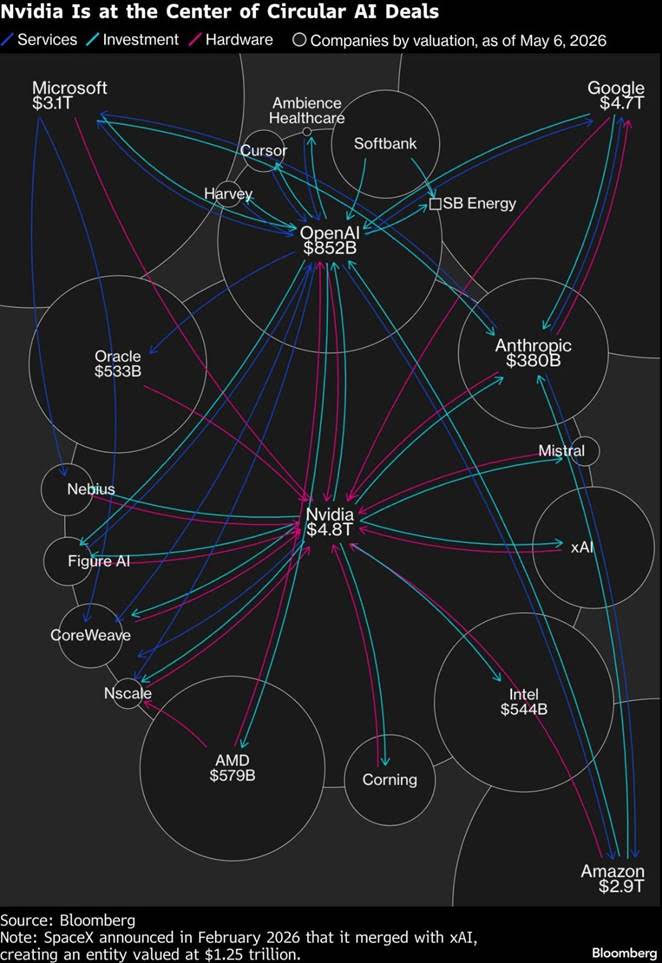
While this is a worrying picture, the defence I would make, having recently read The Thinking Machine about Nvidia, is that founder Jensen Huang is a true believer in AI and its potential. He believed in parallel processing and backed CUDA in 2007 to facilitate the hardware. The long investment cycle without pay-off almost led to a proxy fight by a shareholder activist in 2013. When Ilya Sutskever, who subsequently co-founded OpenAI, and his colleagues published a paper showing the advancement of neural nets using GPU processors, one of his employees, Bryan Catanzaro, pitched the idea of supporting neural nets to Jensen. He was one of the first to grasp AI’s potential and in 2014 turned Nvidia into an AI company. David Kirk, one of Jensen’s direct reports, said, “He got it immediately, before anybody. He was the first to see what it could be. He really was the first.”
By building this ecosystem, Nvidia is generating the raw compute necessary for innovation. It may not be OpenAI or Anthropic who are the winners. There are start-ups pursuing continuous learning, world models, recursive intelligence and other strands of AI that may generate strong advancement towards superintelligence.
The ROI may still ultimately be terrible as true superintelligence could negatively impact the way society or the economy works. And it will likely require a long gestation and diffusion period. China may commoditize the hardware as Huawei rises. In fact, my view is that all this investment will likely generate a similar ROI as the construction of Kyoto (see my brief from two weeks ago). But Jensen isn’t running a Ponzi scheme. He’s running a company that would rather be wrong about the future than miss a once in a generation opportunity.
Russia Likely Doesn’t Launch Tactical Nuclear Weapons
The fact that I spent time to think about it this weekend is a bit worrying, and sad. When the nuclear bomb was successfully tested, Robert Oppenheimer quoted the Bhagavad Gita, “Now I am become Death, the destroyer of worlds.” Nowadays political leaders talk about nukes like some casual item.
Recently, CIA Director John Ratcliffe made a covert trip to meet with Russian intelligence officers. There have been concerns that Russia might attack a NATO member triggering a potential war or conflict.
The most important reason the risk is currently low is that Russia does not appear to need nuclear weapons to prevent a military defeat. The 2026 U.S. intelligence assessment says Moscow still believes it can prevail in Ukraine and that Russia will probably continue to respect the longstanding norm against large-scale chemical, biological and nuclear use unless there is a significant shift in the conflict. Current fighting also points toward continued attritional warfare rather than imminent Russian collapse. Russia is reportedly preparing another large troop expansion while increasing missile production.
A nuclear attack could contaminate territory Russia claims as its own. It also may not materially change the battlefield, would destroy much of Moscow's remaining international political support, and could provoke a devastating Western conventional response. The Bulletin of the Atomic Scientists similarly notes that a single tactical strike offers limited battlefield benefit while creating enormous escalation risks.
What concerns me more than an intentional "out of the blue" nuclear attack is an escalation chain. Ukraine is increasingly hitting Russian refineries and other infrastructure deep inside Russia. Moscow has just threatened British military targets over Ukrainian use of British-supplied missiles. U.S. intelligence explicitly describes an escalation spiral from the Ukraine war into direct Russia–NATO hostilities as the most dangerous Russian threat.
The things that would make me genuinely worried about nuclear escalation would be the movement of nuclear warheads from central storage toward operational units; the visible mating of warheads with Iskander or other tactical delivery systems; unusual command-and-control activity; dispersal of Russian nuclear forces combined with civil-defence measures; senior Russian military discussions analogous to those intercepted in 2022; or a sudden Russian battlefield collapse around Crimea. Open-source analysts currently see no evidence that Russia normally keeps its non-strategic warheads mated to their launchers, which is reassuring.
One somewhat counterintuitive conclusion is that Ukraine doing extremely well militarily could increase the tail risk of nuclear use, whereas today's ugly stalemate and war of attrition probably keep it relatively low. That was essentially the lesson of the dangerous September–October 2022 episode.
End Note
Reading Stanley Druckenmiller’s opinion piece criticizing Scott Bessent’s recent actions at Treasury, I couldn’t help thinking about Kung Fu Panda. The master, Shifu, teaches a way of thinking (although not written by AI). Po is the student who absorbs the master’s methods and eventually goes out into the world with an enormous responsibility.
You could almost model the script:
Druckenmiller/Shifu: What did I teach you about fighting markets? Bessent/Po: Sometimes the government has to intervene when markets aren’t functioning properly. Druckenmiller/Shifu: But the market is functioning. You just don’t like the price.
The opinion piece suggests the only course is cutting the primary deficit and “that you can’t buy your way out of a solvency conversation with liquidity tools.” Druckenmiller’s views speak for themselves: “I have spent five decades trading on a simple premise: Markets aggregate information no committee possesses, and prices are how that information reaches decision makers. The long-term Treasury yield is the most important price in the world. It is also the only fiscal disciplinarian the US has left… The bond market wasn’t being a vigilante, as some would argue,” he wrote. “It was being a pushover that had finally begun to clear its throat, and Treasury moved to quiet even that.”
The yen intervention has failed as the yen retraced back to 160. Treasury yields have inched higher since Bessent’s multiple appearances on CNBC this month. Kevin Warsh, another Druckenmiller protégé, gave an orthodox speech at Jackson Hole prioritizing inflation over employment softness or AI-driven productivity gains. He reiterated rejection of forward guidance, which will increase rate volatility and increase the term premium. All this goes against Bessent’s interventions.
Mr. Bessent may have to go back to the temple and haul water around so he can learn from the Great Shifu.
Omar Sayed