The Printing Press and AI
The London Brief The Printing Press and AI October 10th, 2026
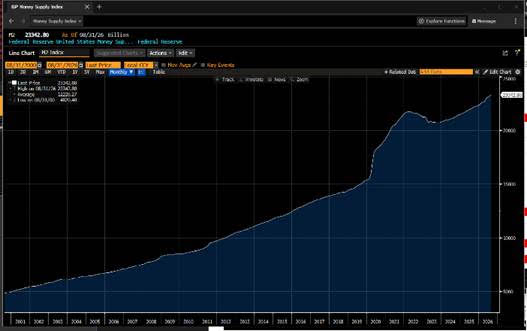
Below is a graph of M2 growth. M2 measures the aggregate amount of dollars in currency, checking and savings accounts. A combination of central bank money printing stemming from the Global Financial Crisis and later Covid, as well as large government deficits is responsible for the money supply growth.
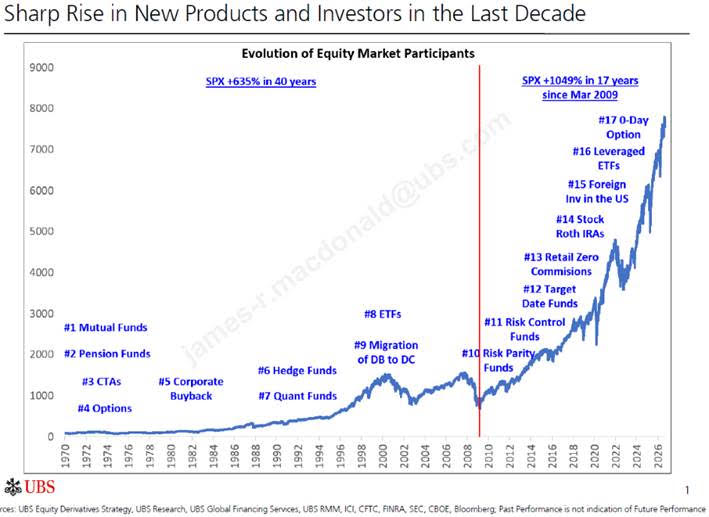
As a result of the monetary expansion, it’s no surprise that there has been a sharp rise in new investment products over the last decade. The chart below looks a lot like the chart above.
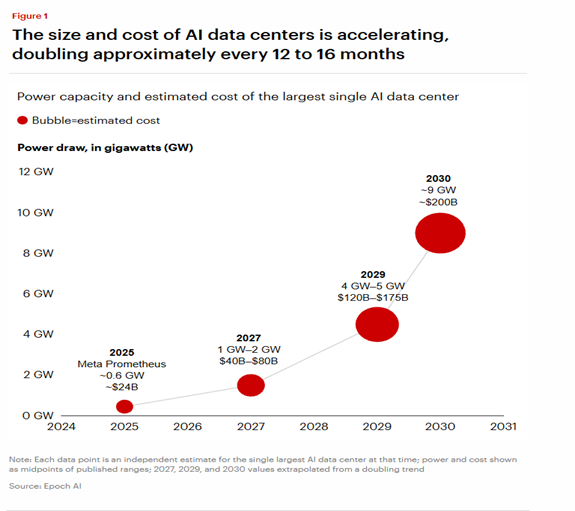
Excess money has a natural gravitational pull to mega-themes. And there is no mega-theme greater than AI. Silicon Valley moguls are attempting to reshape the world with their products. But more importantly for financial conditions, they are trying to do it very quickly, which is making each gigawatt of new compute progressively more expensive.
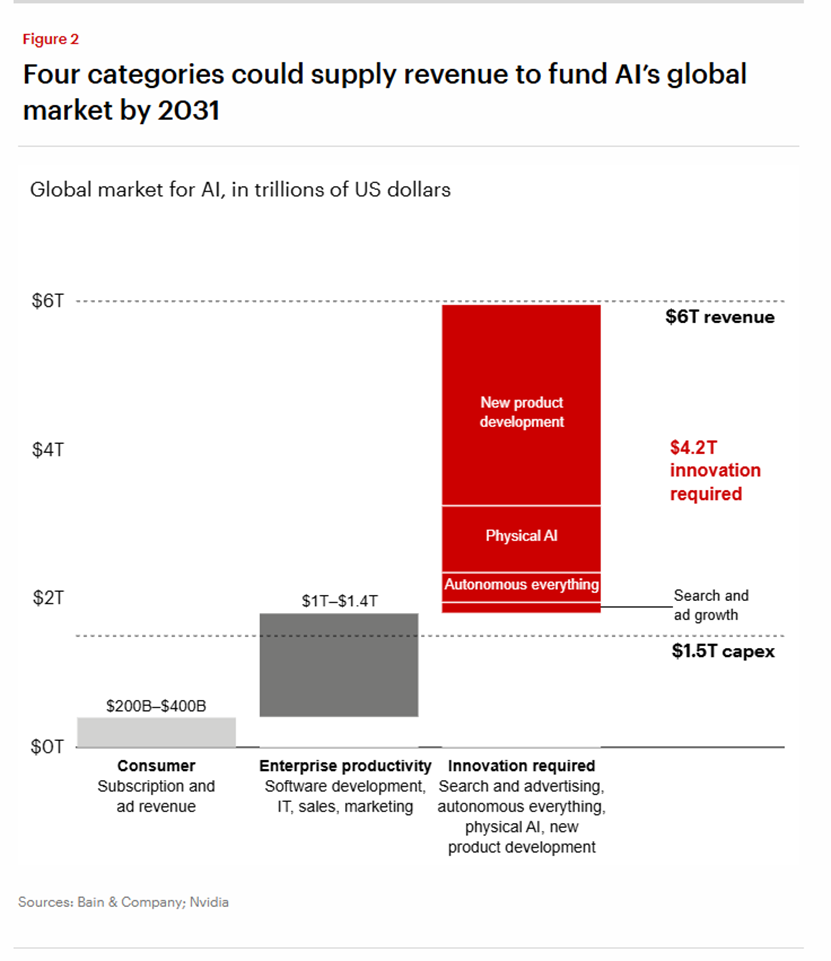
This has led to much debate around how much demand is required to justify a return on the high capex spending levels. UBS has given its best estimate of how much that could be and where it could come from.
With such large numbers, it’s easy to be a bear. And no bear is working the podcast circle most prolifically than Ed Zitron, the tech critic behind the Where’s Your Ed At. In a recent piece, he put together some numbers that are worth breaking down and then evaluating:
· 70% to 80% of all AI revenue and compute demand is OpenAI and Anthropic (Wells Fargo, UBS, Barclays) · $217 to $226bn was fed to the labs over nine months mostly from Google, Nvidia, Amazon, and Microsoft (compilation of sources) · Non-lab compute demand is only $22bn (his estimate) · 80% of the labs’ enterprise revenue comes from 1% of customers, mostly unprofitable start-ups (Ramp and the Information, ‘OpenAI and Anthropic represent 89% of AI startup revenue’) · Hyper-scale capex is estimated at $1.2trn in 2027 (Goldman) · Current AI revenue is $183bn across Google, Microsoft, Amazon, Oracle, and SpaceX of which over 64% are the two labs (his build from sell-side analysts) · Application layer customers would need to generate $425bn (10% margins) or $725bn (assuming the 10% hyperscaler ROIC) to justify the capex (Goldman) · Other sources estimate required application layer revenue of $1.29trn through 2027 (Economist) · Bain says the application layer needs $6 to $7trn of annual revenue globally by 2031 to justify the spend · Zitron’s estimate is $2 to $3trn of annual AI revenue by 2031 · Half of GPU servers sold in 2026-2028 may have nowhere to be plugged in (Morgan Stanley) · $200 to $300bn of Nvidia sales since 2022 are sitting unplugged in warehouses (his estimate) · Microsoft has 2GW of AI-specific capacity in total, but many GPUs are idle because its lack power to install them. · There is $570bn of AI-related debt issuance in 2026 with $250bn being hyperscalers (Morgan Stanley) · Hyperscalers plan to fund about $400bn of AI spend through debt in 2027 (Goldman) · $18bn of Jupiter SPV debt where Oracle is the tenant is stressed. Oracle is seeking to defer payments if the campus misses its 2028 opening (New Mexico has twice denied the gas pipeline meant to feed the campus) · CoreWeave’s $7.75bn of debt was issued at over 9% and has been repriced to 11%-13% · On unit economics, he worked two examples where 5-year contract revenue barely exceeds capex; $1.1bn of capex versus $1.264bn of revenue and $35m of capex versus $44m of revenue before operating expenses and interest · OpenAI and Anthropic’s revenues are $40bn for 2026 (his estimate) · Since 2023, global venture capital has spent $800bn with over $266 bn to the two labs. He believes $300bn of equity is ‘dead money’ · Anthropic had an $8bn loss on $4.6bn of revenue in 2025. 25% of revenues came from two customers. OpenAI spent $34bn to make $13.1bn. · Anthropic took July 31st revenue and multiplied by 365 versus trailing 28 and multiplying by 13; this got them to $65bn annualized versus his $40bn estimate
There’s a lot he writes that does not hold up. First, R&D and training are part of the model. The way he describes Anthropic and OpenAI, every scaling company in history (Amazon, Uber) looks like an economic disaster. Second, the $22bn of ‘real demand’ does not hold up. The Information noted that its figures could double-count AI revenues. So, if an end customer pays Cursor $100, and then Cursor pays Anthropic $100, Anthropic’s revenue isn’t circular hyperscaler money. It’s end customer demand arriving via an intermediary. Excluding the labs from ‘real demand’ understates it. Bloomberg noted earlier in 2026 that 60% of enterprises are paying for AI. Fractal has a 112% net revenue retention. The figures around 1% of customers being 80% of enterprise revenue miss the revenues coming from cloud marketplaces, which is what most large enterprises use.
From my own research working through Anthropic prospectus numbers, a good estimate of Anthropic demand is the following:
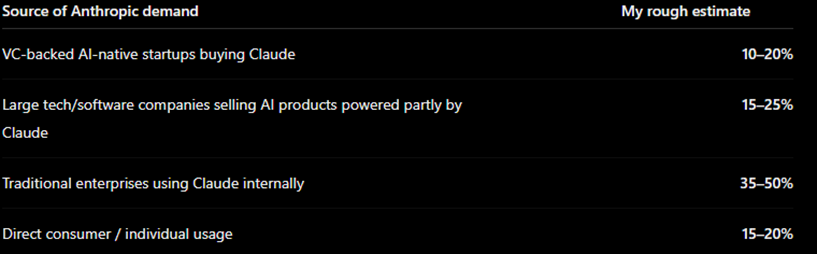
This suggests enterprises have been spending real money on Anthropic, which is in line with anecdotal evidence.
He has no validation that the venture-backed AI companies are ‘dead money’. At this moment, they are revenue-generating customers. To assume their business models won’t scale is presumptious and lacks evidence.
The GPU contracts he used to do his sums on unit economics were based on the lower rates of B300 GPUs which have seen declining spot rates as newer chips come out. However, this is also the pre-condition of the Jevons paradox that the bull case rests on. The lower spot rates mean the cost of inference is declining which supports more demand.
The fact Microsoft can’t plug in its GPUs, the binding constraint is power, not chip supply. It’s not speculative waste.
Anthropic reported positive operating profit in Q2. It reported $11.5bn of revenues in Q2 alone, more than all of 2025. Q1 was roughly $4.8bn. It seems likely Anthropic will crush Zitron’s 2026 estimate and given how each month has grown faster than the next using July 31st x 365 may be realistic.
However, despite all the flaws in his work, he makes several valid points. First, two unprofitable counterparties are underwritten by capital markets access rather than cash flows. If the capital markets turn off, then those companies would become distressed (unless someone bought them). The revenue commitments backing the data centres then also become distressed. On Friday, the FT reported that Amazon is seeking to offload about $8bn of Nvidia chips to external investors through a SPV to reduce its risk. Debt commitments for data centres are getting more expensive, while inflationary costs are pushing up the costs to build one. Stress is showing up in bond pricing, which will make it difficult to issue new bonds.
The demand-side growth is also a big question mark. One data point taken from a recent alternative data conference I attended is that most customers like Anthropic’s lower-level models for routine workflow tasks, with occasionally higher-level models for coding and more complex tasks. Customers are becoming more intelligent on token usage. I see this analysis on multiple podcasts as well. Interestingly, for pure research many felt the higher-level reasoning of the latest frontier models provided worse output than the simple model. Despite larger parameter neural nets, the models are not exhibiting better judgement such that customers want to pay premium prices.
Another datapoint is that the invite-only Instinct and Meta’s Muse agentic AIs do not seem to be working as reliably as the AI boosters proclaim. Muse is having issues with permissions and user consents. Instinct has compute problems. Many users are complaining about reliability such as an impossible flight route or unsatisfactory holiday planning. This is not that surprising as these agents are not as advanced as the agents OpenAI and Anthropic have been testing. The higher-level agents seem to have much greater potential to get the task complete, however, the alignment issue is a major concern. When Anthropic’s own alignment lead puts the odds of AI-driven extinction above 10% this decade, it sounds like a very expensive product liability suit for a corporation. Agents are supposed to be the major demand driver, because they are the human replacement factor. About half of global GDP is knowledge-work. Agentic AI needs to replace about 10% of knowledge labour in 5 years. If this is not the case, then we may have an issue. Remember, AI demand does not only need to grow fast, but it also needs to grow exponentially fast. Huge numbers are required. $7trn is only about 4.5% of projected 2031 global GDP, which sounds manageable until you notice it is roughly the size of today's entire global IT industry. Building that took half a century. AI must do it in five years. That's a lot of AI.
If the exponential demand is not there, the risk of a shock rises sharply. The U.S. government has a significant budget deficit, and it’s been hard for the Treasury to sell Treasury bonds in the 10-30 year range. The 30-year continued to go up, hitting 5.61% during the week, the highest level since 2002. The same deficit-funded liquidity that inflated the AI trade is now being repriced at the long end.
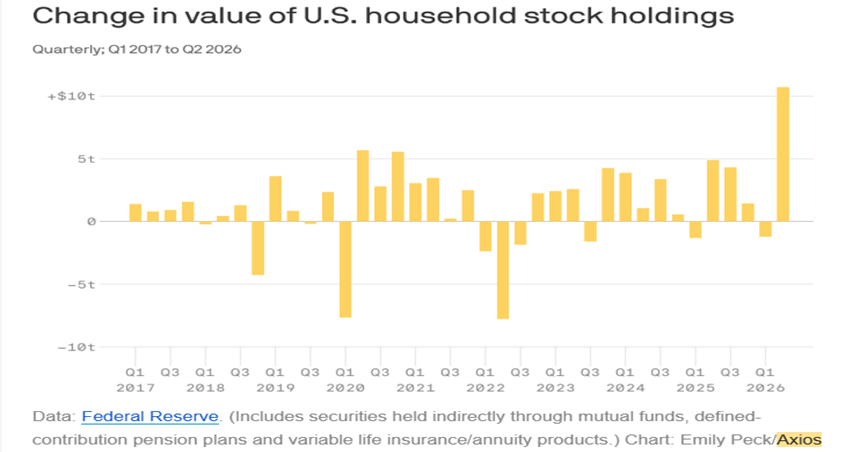
But also look at the chart below. In the second quarter of 2026, U.S. household net worth grew $12.8 trillion, roughly $10.7 trillion of it from equities. Is it any surprise that the economy is running hot? A large share of U.S. GDP growth is AI and equity holders benefitting from AI stocks going up.
On top of this we have two wars (Middle East, Ukraine). Wars are expensive and President Donald Trump is sending a new carrier to the Middle East. French bonds are now trading 141 bps over German Bunds. The market is refusing to give France the benefit of the doubt given the volatility of its politics, and this is impacting other countries like Italy, whose spread to Bunds also widened during the week. The eurozone might rotate holdings from Treasuries into their own bond markets or become a competitor for debt issuance with the U.S. Tokyo is pressuring its pension funds, led by the GPIF, to rotate into domestic assets as it increases its fiscal deficits. Japanese pensions repatriating means a highly significant marginal buyer of U.S. Treasuries may no longer be there. Hedge funds have de-grossed the Treasury basis trade by $200bn, but they still own $1trn. The U.S. government is still issuing copious amounts of new debt and expanding the money supply with no sign yet of reining in spending.
What will make the printing presses stop? The most likely trigger is a lack of bond demand that forces the U.S. government to rein in its fiscal deficit (the bond vigilante scenario). We are seeing this play out in multiple sovereign bond markets. Another scenario is the Fed hiking interest rates further. But initial comments this week suggest no Fed hike at the next FOMC meeting and Fed hikes don’t necessarily stop the Treasury from running deficits that keep the money supply growing. A third trigger could be the AI demand curve (or lack of it) makes the market believe that these data centres will not deliver ROIC, which triggers an AI crash, which then creates a more general liquidity pop from declines in the private credit market. Forcing central banks to print money again will just boost inflation. Not printing money potentially creates a recession. But inflation is worse than a recession as it just grinds away our social cohesion. The economist Joseph Schumpeter once said downturns were part of the process of “creative destruction”. It seems apropos here. And maybe you can buy a value stock again.
End Note
I was listening to the My First Million podcast, and they discussed a survey where people asked whether if they were given $10m equivalent would they travel back to 1500 with that money and live. No one would take the money, presumably because the plague isn’t a selling point.
However, I was watching an old classic from my youth, Steven Spielberg’s The Goonies with my boys. The film is set in a seaside town in Oregon from the 1980s. At first there was resistance to watching a film that is more than 40 years old. Sardonic comments were made on the opening credit visuals. When I told them give it five minutes and if you don’t like it, we could watch Ted Lasso, they gave it a shot. Spielberg’s magic did his thing and after five minutes they were hooked, and no one demanded the switch. While they made one comment about how the kids had to use a payphone to communicate, they didn’t really make fun of my childhood.
At the dinner table, I then posed to my sons the same question as My First Million, on the question whether they would take $10 million back to the 1980s and I surprisingly got little resistance. I think my kids appreciated how there was less pressure to learn AI so they could get a job in the future. And they seemed to realize if you don’t have smartphones, you hang out with people. There was also a sense of town community in the film. The film also showed working class families living in affordable, nice homes.
The 1500s question measures what progress has given us, but it’s rigged. Nobody wants pre-modern medicine. The 1980s question measures what progress has cost in community, affordable housing and a less anxious path to a job.
Omar Sayed